Wednesday, 14 January 2015

The Skylight Room by O. Henry


The Skylight Room

by


First Mrs. Parker would show you the double parlours. You would not dare to interrupt her description of their advantages and of the merits of the gentleman who had occupied them for eight years. Then you would manage to stammer forth the confession that you were neither a doctor nor a dentist. Mrs. Parker's manner of receiving the admission was such that you could never afterward entertain the same feeling toward your parents, who had neglected to train you up in one of the professions that fitted Mrs. Parker's parlours.
Next you ascended one flight of stairs and looked at the second- floor-back at $8. Convinced by her second-floor manner that it was worth the $12 that Mr. Toosenberry always paid for it until he left to take charge of his brother's orange plantation in Florida near Palm Beach, where Mrs. McIntyre always spent the winters that had the double front room with private bath, you managed to babble that you wanted something still cheaper.
If you survived Mrs. Parker's scorn, you were taken to look at Mr. Skidder's large hall room on the third floor. Mr. Skidder's room was not vacant. He wrote plays and smoked cigarettes in it all day long. But every room-hunter was made to visit his room to admire the lambrequins. After each visit, Mr. Skidder, from the fright caused by possible eviction, would pay something on his rent.
Then--oh, then--if you still stood on one foot, with your hot hand clutching the three moist dollars in your pocket, and hoarsely proclaimed your hideous and culpable poverty, nevermore would Mrs. Parker be cicerone of yours. She would honk loudly the word" Clara," she would show you her back, and march downstairs. Then Clara, the coloured maid, would escort you up the carpeted ladder that served for the fourth flight, and show you the Skylight Room. It occupied 7x8 feet of floor space at the middle of the hall. On each side of it was a dark lumber closet or storeroom.
In it was an iron cot, a washstand and a chair. A shelf was the dresser. Its four bare walls seemed to close in upon you like the sides of a coffin. Your hand crept to your throat, you gasped, you looked up as from a well--and breathed once more. Through the glass of the little skylight you saw a square of blue infinity.
"Two dollars, suh," Clara would say in her half-contemptuous, half- Tuskegeenial tones.
One day Miss Leeson came hunting for a room. She carried a typewriter made to be lugged around by a much larger lady. She was a very little girl, with eyes and hair that had kept on growing after she had stopped and that always looked as if they were saying: "Goodness me ! Why didn't you keep up with us?"
Mrs. Parker showed her the double parlours. "In this closet," she said, "one could keep a skeleton or anaesthetic or coal "
"But I am neither a doctor nor a dentist," said Miss Leeson, with a shiver.
Mrs. Parker gave her the incredulous, pitying, sneering, icy stare that she kept for those who failed to qualify as doctors or dentists, and led the way to the second floor back.
"Eight dollars?" said Miss Leeson. "Dear me! I'm not Hetty if I do look green. I'm just a poor little working girl. Show me something higher and lower."
Mr. Skidder jumped and strewed the floor with cigarette stubs at the rap on his door.
"Excuse me, Mr. Skidder," said Mrs. Parker, with her demon's smile at his pale looks. "I didn't know you were in. I asked the lady to have a look at your lambrequins."
"They're too lovely for anything," said Miss Leeson, smiling in exactly the way the angels do.
After they had gone Mr. Skidder got very busy erasing the tall, black-haired heroine from his latest (unproduced) play and inserting a small, roguish one with heavy, bright hair and vivacious features.
"Anna Held'll jump at it," said Mr. Skidder to himself, putting his feet up against the lambrequins and disappearing in a cloud of smoke like an aerial cuttlefish.
Presently the tocsin call of "Clara!" sounded to the world the state of Miss Leeson's purse. A dark goblin seized her, mounted a Stygian stairway, thrust her into a vault with a glimmer of light in its top and muttered the menacing and cabalistic words "Two dollars!"
"I'll take it!" sighed Miss Leeson, sinking down upon the squeaky iron bed.
Every day Miss Leeson went out to work. At night she brought home papers with handwriting on them and made copies with her typewriter. Sometimes she had no work at night, and then she would sit on the steps of the high stoop with the other roomers. Miss Leeson was not intended for a sky-light room when the plans were drawn for her creation. She was gay-hearted and full of tender, whimsical fancies. Once she let Mr. Skidder read to her three acts of his great (unpublished) comedy, "It's No Kid; or, The Heir of the Subway."
There was rejoicing among the gentlemen roomers whenever Miss Leeson had time to sit on the steps for an hour or two. But Miss Longnecker, the tall blonde who taught in a public school and said, "Well, really!" to everything you said, sat on the top step and sniffed. And Miss Dorn, who shot at the moving ducks at Coney every Sunday and worked in a department store, sat on the bottom step and sniffed. Miss Leeson sat on the middle step and the men would quickly group around her.
Especially Mr. Skidder, who had cast her in his mind for the star part in a private, romantic (unspoken) drama in real life. And especially Mr. Hoover, who was forty-five, fat, flush and foolish. And especially very young Mr. Evans, who set up a hollow cough to induce her to ask him to leave off cigarettes. The men voted her "the funniest and jolliest ever," but the sniffs on the top step and the lower step were implacable.
* * * * * *
I pray you let the drama halt while Chorus stalks to the footlights and drops an epicedian tear upon the fatness of Mr. Hoover. Tune the pipes to the tragedy of tallow, the bane of bulk, the calamity of corpulence. Tried out, Falstaff might have rendered more romance to the ton than would have Romeo's rickety ribs to the ounce. A lover may sigh, but he must not puff. To the train of Momus are the fat men remanded. In vain beats the faithfullest heart above a 52-inch belt. Avaunt, Hoover! Hoover, forty-five, flush and foolish, might carry off Helen herself; Hoover, forty-five, flush, foolish and fat is meat for perdition. There was never a chance for you, Hoover.
As Mrs. Parker's roomers sat thus one summer's evening, Miss Leeson looked up into the firmament and cried with her little gay laugh:
"Why, there's Billy Jackson! I can see him from down here, too."
All looked up--some at the windows of skyscrapers, some casting about for an airship, Jackson-guided.
"It's that star," explained Miss Leeson, pointing with a tiny finger. "Not the big one that twinkles--the steady blue one near it. I can see it every night through my skylight. I named it Billy Jackson."
"Well, really!" said Miss Longnecker. "I didn't know you were an astronomer, Miss Leeson."
"Oh, yes," said the small star gazer, "I know as much as any of them about the style of sleeves they're going to wear next fall in Mars."
"Well, really!" said Miss Longnecker. "The star you refer to is Gamma, of the constellation Cassiopeia. It is nearly of the second magnitude, and its meridian passage is--"
"Oh," said the very young Mr. Evans, "I think Billy Jackson is a much better name for it."
"Same here," said Mr. Hoover, loudly breathing defiance to Miss Longnecker. "I think Miss Leeson has just as much right to name stars as any of those old astrologers had."
"Well, really!" said Miss Longnecker.
"I wonder whether it's a shooting star," remarked Miss Dorn. "I hit nine ducks and a rabbit out of ten in the gallery at Coney Sunday."
"He doesn't show up very well from down here," said Miss Leeson. "You ought to see him from my room. You know you can see stars even in the daytime from the bottom of a well. At night my room is like the shaft of a coal mine, and it makes Billy Jackson look like the big diamond pin that Night fastens her kimono with."
There came a time after that when Miss Leeson brought no formidable papers home to copy. And when she went out in the morning, instead of working, she went from office to office and let her heart melt away in the drip of cold refusals transmitted through insolent office boys. This went on.
There came an evening when she wearily climbed Mrs. Parker's stoop at the hour when she always returned from her dinner at the restaurant. But she had had no dinner.
As she stepped into the hall Mr. Hoover met her and seized his chance. He asked her to marry him, and his fatness hovered above her like an avalanche. She dodged, and caught the balustrade. He tried for her hand, and she raised it and smote him weakly in the face. Step by step she went up, dragging herself by the railing. She passed Mr. Skidder's door as he was red-inking a stage direction for Myrtle Delorme (Miss Leeson) in his (unaccepted) comedy, to "pirouette across stage from L to the side of the Count." Up the carpeted ladder she crawled at last and opened the door of the skylight room.
She was too weak to light the lamp or to undress. She fell upon the iron cot, her fragile body scarcely hollowing the worn springs. And in that Erebus of the skylight room, she slowly raised her heavy eyelids, and smiled.
For Billy Jackson was shining down on her, calm and bright and constant through the skylight. There was no world about her. She was sunk in a pit of blackness, with but that small square of pallid light framing the star that she had so whimsically and oh, so ineffectually named. Miss Longnecker must be right; it was Gamma, of the constellation Cassiopeia, and not Billy Jackson. And yet she could not let it be Gamma.
As she lay on her back she tried twice to raise her arm. The third time she got two thin fingers to her lips and blew a kiss out of the black pit to Billy Jackson. Her arm fell back limply.
"Good-bye, Billy," she murmured faintly. "You're millions of miles away and you won't even twinkle once. But you kept where I could see you most of the time up there when there wasn't anything else but darkness to look at, didn't you? . . . Millions of miles. . . . Good-bye, Billy Jackson."
Clara, the coloured maid, found the door locked at 10 the next day, and they forced it open. Vinegar, and the slapping of wrists and burnt feathers proving of no avail, some one ran to 'phone for an ambulance.
In due time it backed up to the door with much gong-clanging, and the capable young medico, in his white linen coat, ready, active, confident, with his smooth face half debonair, half grim, danced up the steps.
"Ambulance call to 49," he said briefly. "What's the trouble?"
"Oh, yes, doctor," sniffed Mrs. Parker, as though her trouble that there should be trouble in the house was the greater. "I can't think what can be the matter with her. Nothing we could do would bring her to. It's a young woman, a Miss Elsie--yes, a Miss Elsie Leeson. Never before in my house--"
"What room?" cried the doctor in a terrible voice, to which Mrs. Parker was a stranger.
"The skylight room. It--
Evidently the ambulance doctor was familiar with the location of skylight rooms. He was gone up the stairs, four at a time. Mrs. Parker followed slowly, as her dignity demanded.
On the first landing she met him coming back bearing the astronomer in his arms. He stopped and let loose the practised scalpel of his tongue, not loudly. Gradually Mrs. Parker crumpled as a stiff garment that slips down from a nail. Ever afterward there remained crumples in her mind and body. Sometimes her curious roomers would ask her what the doctor said to her.
"Let that be," she would answer. "If I can get forgiveness for having heard it I will be satisfied."
The ambulance physician strode with his burden through the pack of hounds that follow the curiosity chase, and even they fell back along the sidewalk abashed, for his face was that of one who bears his own dead.
They noticed that he did not lay down upon the bed prepared for it in the ambulance the form that he carried, and all that he said was: "Drive like h**l, Wilson," to the driver.
That is all. Is it a story? In the next morning's paper I saw a little news item, and the last sentence of it may help you (as it helped me) to weld the incidents together.
It recounted the reception into Bellevue Hospital of a young woman who had been removed from No. 49 East -- street, suffering from debility induced by starvation. It concluded with these words:
"Dr. William Jackson, the ambulance physician who attended the case, says the patient will recover."



Sunday, 11 January 2015

The Little Match Girl by Hans Christian Andersen

The Little Match Girl

by


Although he is well noted for his fairy-tales, the poignant story of The Little Match Girl or The Little Matchstick Girl, is a great example of Hans Christian Andersen's broad literary talent.
An illustration for the story The Little Match Girl by the author Hans Christian Andersen
Most terribly cold it was; it snowed, and was nearly quite dark, and evening-- the last evening of the year. In this cold and darkness there went along the street a poor little girl, bareheaded, and with naked feet. When she left home she had slippers on, it is true; but what was the good of that? They were very large slippers, which her mother had hitherto worn; so large were they; and the poor little thing lost them as she scuffled away across the street, because of two carriages that rolled by dreadfully fast.
One slipper was nowhere to be found; the other had been laid hold of by an urchin, and off he ran with it; he thought it would do capitally for a cradle when he some day or other should have children himself. So the little maiden walked on with her tiny naked feet, that were quite red and blue from cold. She carried a quantity of matches in an old apron, and she held a bundle of them in her hand. Nobody had bought anything of her the whole livelong day; no one had given her a single farthing.
She crept along trembling with cold and hunger--a very picture of sorrow, the poor little thing!
The flakes of snow covered her long fair hair, which fell in beautiful curls around her neck; but of that, of course, she never once now thought. From all the windows the candles were gleaming, and it smelt so deliciously of roast goose, for you know it was New Year's Eve; yes, of that she thought.
In a corner formed by two houses, of which one advanced more than the other, she seated herself down and cowered together. Her little feet she had drawn close up to her, but she grew colder and colder, and to go home she did not venture, for she had not sold any matches and could not bring a farthing of money: from her father she would certainly get blows, and at home it was cold too, for above her she had only the roof, through which the wind whistled, even though the largest cracks were stopped up with straw and rags.
Her little hands were almost numbed with cold. Oh! a match might afford her a world of comfort, if she only dared take a single one out of the bundle, draw it against the wall, and warm her fingers by it. She drew one out. "Rischt!" how it blazed, how it burnt! It was a warm, bright flame, like a candle, as she held her hands over it: it was a wonderful light. It seemed really to the little maiden as though she were sitting before a large iron stove, with burnished brass feet and a brass ornament at top. The fire burned with such blessed influence; it warmed so delightfully. The little girl had already stretched out her feet to warm them too; but--the small flame went out, the stove vanished: she had only the remains of the burnt-out match in her hand.
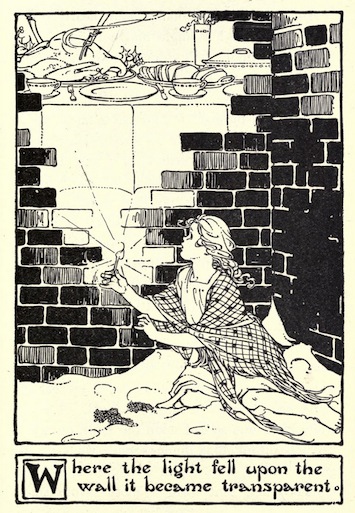
She rubbed another against the wall: it burned brightly, and where the light fell on the wall, there the wall became transparent like a veil, so that she could see into the room. On the table was spread a snow-white tablecloth; upon it was a splendid porcelain service, and the roast goose was steaming famously with its stuffing of apple and dried plums. And what was still more capital to behold was, the goose hopped down from the dish, reeled about on the floor with knife and fork in its breast, till it came up to the poor little girl; when--the match went out and nothing but the thick, cold, damp wall was left behind. She lighted another match. Now there she was sitting under the most magnificent Christmas tree: it was still larger, and more decorated than the one which she had seen through the glass door in the rich merchant's house.
Thousands of lights were burning on the green branches, and gaily-colored pictures, such as she had seen in the shop-windows, looked down upon her. The little maiden stretched out her hands towards them when--the match went out. The lights of the Christmas tree rose higher and higher, she saw them now as stars in heaven; one fell down and formed a long trail of fire.
"Someone is just dead!" said the little girl; for her old grandmother, the only person who had loved her, and who was now no more, had told her, that when a star falls, a soul ascends to God.
She drew another match against the wall: it was again light, and in the lustre there stood the old grandmother, so bright and radiant, so mild, and with such an expression of love.
"Grandmother!" cried the little one. "Oh, take me with you! You go away when the match burns out; you vanish like the warm stove, like the delicious roast goose, and like the magnificent Christmas tree!" And she rubbed the whole bundle of matches quickly against the wall, for she wanted to be quite sure of keeping her grandmother near her. And the matches gave such a brilliant light that it was brighter than at noon-day: never formerly had the grandmother been so beautiful and so tall. She took the little maiden, on her arm, and both flew in brightness and in joy so high, so very high, and then above was neither cold, nor hunger, nor anxiety--they were with God.
But in the corner, at the cold hour of dawn, sat the poor girl, with rosy cheeks and with a smiling mouth, leaning against the wall--frozen to death on the last evening of the old year. Stiff and stark sat the child there with her matches, of which one bundle had been burnt. "She wanted to warm herself," people said. No one had the slightest suspicion of what beautiful things she had seen; no one even dreamed of the splendor in which, with her grandmother she had entered on the joys of a new year.

Party Like A PUNJABI Gippy grewal


A Shameful Affair by Kate Chopin

A Shameful Affair

by


Mildred Orme, seated in the snuggest corner of the big front porch of the Kraummer farmhouse, was as content as a girl need hope to be.
This was no such farm as one reads about in humorous fiction. Here were swelling acres where the undulating wheat gleamed in the sun like a golden sea. For silver there was the Meramec or, better, it was pure crystal, for here and there one might look clean through it down to where the pebbles lay like green and yellow gems. Along the river's edge trees were growing to the very water, and in it, sweeping it when they were willows.
The house itself was big and broad, as country houses should be. The master was big and broad, too. The mistress was small and thin, and it was always she who went out at noon to pull the great clanging bell that called the farmhands in to dinner.
From her agreeable corner where she lounged with her Browning or her Ibsen, Mildred watched the woman do this every day. Yet when the clumsy farmhands all came tramping up the steps and crossed the porch in going to their meal that was served within, she never looked at them. Why should she? Farmhands are not so very nice to look at, and she was nothing of an anthropologist. But once when the half dozen men came along, a paper which she had laid carelessly upon the railing was blown across their path. One of them picked it up, and when he had mounted the steps restored it to her. He was young, and brown, of course, as the sun had made him. He had nice blue eyes. His fair hair was dishevelled. His shoulders were broad and square and his limbs strong and clean. A not unpicturesque figure in the rough attire that bared his throat to view and gave perfect freedom to his every motion.
Mildred did not make these several observations in the half second that she looked at him in courteous acknowledgment. It took her as many days to note them all. For she signaled him out each time that he passed her, meaning to give him a condescending little smile, as she knew how. But he never looked at her. To be sure, clever young women of twenty, who are handsome, besides, who have refused their half dozen offers and are settling down to the conviction that life is a tedious affair, are not going to care a straw whether farmhands look at them or not. And Mildred did not care, and the thing would not have occupied her a moment if Satan had not intervened, in offering the employment which natural conditions had failed to supply. It was summer time; she was idle; she was piqued, and that was the beginning of the shameful affair.
"Who are these men, Mrs. Kraummer, that work for you? Where do you pick them up?"
"Oh, ve picks 'em up everyvere. Some is neighbors, some is tramps, and so."
"And that broad-shouldered young fellow is he a neighbor? The one who handed me my paper the other day you remember?"
"Gott, no! You might yust as well say he vas a tramp. Aber he vorks like a steam ingine."
"Well, he's an extremely disagreeable-looking man. I should think you'd be afraid to have him about, not knowing him."
"Vat you vant to be 'fraid for?" laughed the little woman. "He don't talk no more un ven he vas deef und dumb. I didn't t'ought you vas sooch a baby."
"But, Mrs. Kraummer, I don't want you to think I'm a baby, as you say a coward, as you mean. Ask the man if he will drive me to church tomorrow. You see, I'm not so very much afraid of him," she added with a smile.
The answer which this unmannerly farmhand returned to Mildred's request was simply a refusal. He could not drive her to church because he was going fishing.
"Aber," offered good Mrs. Kraummer, "Hans Platzfeldt will drive you to church, oder verever you vants. He vas a goot boy vat you can trust, dat Hans."
"Oh, thank him very much. But I find I have so many letters to write tomorrow, and it promises to be hot, too. I shan't care to go to church after all."
She could have cried for vexation. Snubbed by a farmhand! a tramp, perhaps. She, Mildred Orme, who ought really to have been with the rest of the family at Narragansett who had come to seek in this retired spot the repose that would enable her to follow exalted lines of thought. She marveled at the problematic nature of farmhands.
After sending her the uncivil message already recorded, and as he passed beneath the porch where she sat, he did look at her finally, in a way to make her positively gasp at the sudden effrontery of the man.
But the inexplicable look stayed with her. She could not banish it.
II
It was not so very hot after all, the next day, when Mildred walked down the long narrow footpath that led through the bending wheat to the river. High above her waist reached the yellow grain. Mildred's brown eyes filled with a reflected golden light as they caught the glint of it, as she heard the trill that it answered to the gentle breeze. Anyone who has walked through the wheat in midsummer-time knows that sound.
In the woods it was sweet and solemn and cool. And there beside the river was the wretch who had annoyed her, first, with his indifference, then with the sudden boldness of his glance.
"Are you fishing?" she asked politely and with kindly dignity, which she supposed would define her position toward him. The inquiry lacked not pertinence, seeing that he sat motionless, with a pole in his hand and his eyes fixed on a cork that bobbed aimlessly on the water.
"Yes, madam," was his brief reply.
"It won't disturb you if I stand here a moment, to see what success you will have?"
"No, madam."
She stood very still, holding tight to the book she had brought with her. Her straw hat had slipped disreputably to one side, over the wavy bronzebrown bang that half covered her forehead. Her cheeks were ripe with color that the sun had coaxed there; so were her lips.
All the other farmhands had gone forth in Sunday attire. Perhaps this one had none better than these working clothes that he wore. A feminine commiseration swept her at the thought. He spoke never a word. She wondered how many hours he could sit there, so patiently waiting for fish to come to his hook. For her part, the situation began to pall, and she wanted to change it at last.
"Let me try a moment, please? I have an idea."
"Yes, madam."
"The man is surely an idiot, with his monosyllables," she commented inwardly. But she remembered that monosyllables belong to a boor's equipment.
She laid her book carefully down and took the pole gingerly that he came to place in her hands. Then it was his turn to stand back and look respectfully and silently on at the absorbing performance.
"Oh!" cried the girl, suddenly, seized with excitement upon seeing the line dragged deep in the water.
"Wait, wait! Not yet."
He sprang to her side. With his eyes eagerly fastened on the tense line, he grasped the pole to prevent her drawing it, as her intention seemed to be. That is, he meant to grasp the pole, but instead, his brown hand came down upon Mildred's white one.
He started violently at finding himself so close to a bronze-brown tangle that almost swept his chin to a hot cheek only a few inches away from his shoulder, to a pair of young, dark eyes that gleamed for an instant unconscious things into his own.
Then, why ever it happened, or how ever it happened, his arms were holding Mildred and he kissed her lips. She did not know if it was ten times or only once.
She looked around her face milk-white to see him disappear with rapid strides through the path that had brought her there. Then she was alone.
Only the birds had seen, and she could count on their discretion. She was not wildly indignant, as many would have been. Shame stunned her. But through it she gropingly wondered if she should tell the Kraummers that her chaste lips had been rifled of their innocence. Publish her own confusion? No! Once in her room she would give calm thought to the situation, and determine then how to act. The secret must remain her own: a hateful burden to bear alone until she could forget it.
III
And because she feared not to forget it, Mildred wept that night. All day long a hideous truth had been thrusting itself upon her that made her ask herself if she could be mad. She feared it. Else why was that kiss the most delicious thing she had known in her twenty years of life? The sting of it had never left her lips since it was pressed into them. The sweet trouble of it banished sleep from her pillow.
But Mildred would not bend the outward conditions of her life to serve any shameful whim that chanced to visit her soul, like an ugly dream. She would avoid nothing. She would go and come as always.
In the morning she found in her chair upon the porch the book she had left by the river. A fresh indignity! But she came and went as she intended to, and sat as usual upon the porch amid her familiar surroundings. When the Offender passed her by she knew it, though her eyes were never lifted. Are there only sight and sound to tell such things? She discerned it by a wave that swept her with confusion and she knew not what besides.
She watched him furtively, one day, when he talked with Farmer Kraummer out in the open. When he walked away she remained like one who has drunk much wine. Then unhesitatingly she turned and began her preparations to leave the Kraummer farmhouse.
When the afternoon was far spent they brought letters to her. One of them read like this:
"My Mildred, deary! I am only now at Narragansett, and so broke up not to find you. So you are down at that Kraummer farm, on the Iron Mountain. Well! What do you think of that delicious crank, Fred Evelyn? For a man must be a crank who does such things. Only fancy! Last year he chose to drive an engine back and forth across the plains. This year he tills the soil with laborers. Next year it will be something else as insane because he likes to live more lives than one kind, and other Quixotic reasons. We are great chums. He writes me he's grown as strong as an ox. But he hasn't mentioned that you are there. I know you don't get on with him, for he isn't a bit intellectual detests Ibsen and abuses Tolstoi. He doesn't read 'in books' says they are spectacles for the shortsighted to look at life through. Don't snub him, dear, or be too hard on him; he has a heart of gold, if he is the first crank in America."
Mildred tried to think to feel that the intelligence which this letter brought to her would take somewhat of the sting from the shame that tortured her. But it did not. She knew that it could not.
In the gathering twilight she walked again through the wheat that was heavy and fragrant with dew. The path was very long and very narrow. When she was midway she saw the Offender coming toward her. What could she do? Turn and run, as a little child might? Spring into the wheat, as some frightened four-footed creature would? There was nothing but to pass him with the dignity which the occasion clearly demanded.
But he did not let her pass. He stood squarely in the pathway before her, hat in hand, a perturbed look upon his face.
"Miss Orme," he said, "I have wanted to say to you, every hour of the past week, that I am the most consummate hound that walks the earth."
She made no protest. Her whole bearing seemed to indicate that her opinion coincided with his own.
"If you have a father, or brother, or any one, in short, to whom you may say such things "
"I think you aggravate the offense, sir, by speaking of it. I shall ask you never to mention it again. I want to forget that it ever happened. Will you kindly let me by."
"Oh," he ventured eagerly, "you want to forget it! Then, maybe, since you are willing to forget, you will be generous enough to forgive the offender some day?"
"Some day," she repeated, almost inaudibly, looking seemingly through him, but not at him "some day perhaps; when I shall have forgiven myself."
He stood motionless, watching her slim, straight figure lessening by degrees as she walked slowly away from him. He was wondering what she meant. Then a sudden, quick wave came beating into his brown throat and staining it crimson, when he guessed what it might be.